By
Marie-Anne Grangeret
07 Sep 26
•
8
min read
Share this article


<script async type="module"
src="https://cdn.jsdelivr.net/npm/@finsweet/attributes@2/attributes.js"
fs-socialshare
></script>
<!-- Finsweet Attributes -->
<script async type="module"
src="https://cdn.jsdelivr.net/npm/@finsweet/attributes@2/attributes.js"
fs-copyclip
></script>
<!-- Finsweet Attributes -->
<script async type="module"
src="https://cdn.jsdelivr.net/npm/@finsweet/attributes@2/attributes.js"
fs-toc
></script>

Frequently asked questions
Drills, rotary hammers, grinders, jackhammers: all power tools transmit vibrations to the hands and arms of the user. We know these vibrations exist. What we understand less are their effects on the body, how to measure them, and why the figure on a tool's technical data sheet doesn't tell the whole story about the actual risk. This article reviews a study conducted by MOTEN Technologies for Bosch, which measures vibration exposure for construction workers on the job site.
What is meant by "hand-arm vibration"?
When a tool rotates or strikes, it generates mechanical oscillations. These oscillations travel from the handles to the hands and then the arms. This is what is known as hand-arm system vibration exposure.
Occasional exposure is harmless. The problem arises from repetition, day after day, year after year. Known and recognized occupational diseases include, for example:
- Damage to blood vessels: the well-known "white finger syndrome," or occupational Raynaud's syndrome, where fingers lose color and blood flow.
- Nervous system damage: numbness, loss of sensitivity to heat and cold, and loss of dexterity.
- Worsening of musculoskeletal disorders (MSDs), which can lead to carpal tunnel syndrome.
This risk is by no means marginal: more than 10% of employees are exposed to it across almost all sectors of activity—construction, woodworking, mechanical workshops, foundries, and quarries.
A tool's technical data sheet is not always synonymous with risk management
Every manufacturer is required to declare the vibration level of their tools. However, this value is often measured on the tool itself, on a test bench, under standardized laboratory conditions. It is useful for comparing machines, but it says nothing about what users actually receive in their hands.
Actual exposure depends on a host of factors: the characteristics of the consumable, the material being drilled or cut, how the tool is held, the amount of pressure applied, the use of gloves, fatigue at the end of the day, and tool proficiency. Two workers using the same rotary hammer may have different levels of risk exposure.
More and more safety professionals are asking themselves the question of the difference between manufacturer data and real-world measurements. This is why MOTEN was involved in this study.
The MOTEN approach: measuring reality
Bosch commissioned MOTEN to develop a method for evaluating hand-arm vibrations generated by the use of power tools in real-world work situations. The company has the equipment and testing facilities at its Saint-Ouen-sur-Seine site to characterize vibrating tools; the challenge was to build a reproducible protocol to measure actual exposure based on the tool, consumables, and protective equipment.
To do this, MOTEN mobilizes three complementary areas of expertise—sensors, data, and ergonomics—around a new generation of sensor technology. This sensor characterizes four essential indicators for occupational health: muscle activity, strenuous postures, repetitive movements, and vibrations. It is this last area that concerns us for this study.
The principle is simple: the sensor is placed on the worker and measures what is actually transmitted to the hand-arm system during work.
The approach: a rigorous protocol for objective comparison
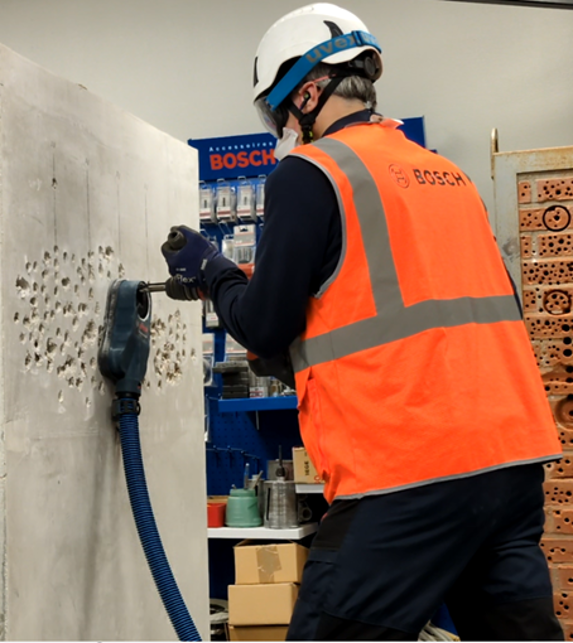
The study compared the Bosch EXBH18V-32F cordless rotary hammer with a competitor's model in the same class, using a wide range of consumables (Bosch, Pro, and Expert drill bits, as well as competing products).
To ensure the comparison was reliable, everything was kept identical from one test to the next: the same drilling diameter (14 mm), the same depth (140 mm), drilling into concrete walls both with and without rebar, and on a horizontal plane at a constant height. The tests were alternated to neutralize any potential fatigue effect on the volunteer operators.
The MOTEN sensor was placed on the upper limbs—deltoids, biceps, forearm flexors, and the back of the hands—to track vibration propagation along the arm. To ensure only relevant data was captured, only the final seconds of each drilling operation, with the tool at full depth, were analyzed using video synchronization.
Two key concepts for interpreting the results
Frequency weighting
Certain frequencies are more harmful to the hand than others. For the hand-arm system, the relevant range is 8 to 1000 Hz, with the most harmful frequencies falling between 6 and 26 Hz. We therefore apply a "weighting" (defined by the ISO 8041 standard) that gives more weight to the frequencies that are truly dangerous. In other words, we aren't just measuring "how much it vibrates", but "how much it vibrates where it is dangerous".
The daily exposure value A(8)
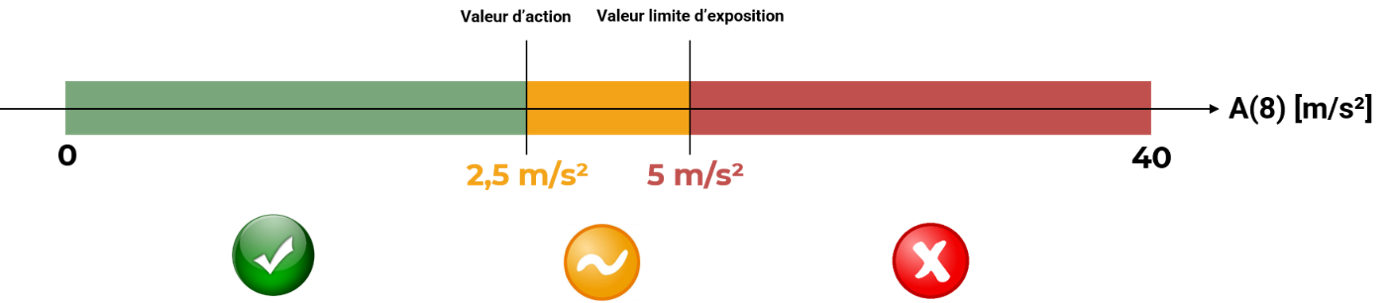
The daily exposure value, denoted as A(8), scales the vibration intensity to an 8-hour workday. It is interpreted against two thresholds set by European Directive 2002/44/EC:
- 2.5 m/s², the action value: beyond this, the employer must implement preventive measures.
- 5 m/s², the exposure limit value: a ceiling that must never be exceeded.
The benefit of the A(8) value is that it translates directly into permissible usage time: the more a tool vibrates, the less time it can be used during the day without risk.
The results
Vibrations are absorbed by the hands
Thanks to sensors placed from the wrist to the shoulder, an initial finding: vibration intensity drops sharply along the arm (by about 45% to 78% between the hand and the shoulder, depending on the configuration). Simply put, most of the vibratory energy is absorbed by the hands. Therefore, the values measured at both hands served as the reference for the entire analysis.
The Bosch tool reduces measured hand exposure
Across all consumables, the Bosch rotary hammer shows an A(8) value lower than that of the competitor tested: -16% for the right hand and -13% for the left hand. In practical terms, this means it can be used for longer before reaching the 5 m/s² limit: 74 minutes versus 67, gaining 7 minutes of margin throughout the day.
Consumables and the material matter as much as the tool
Vibration intensity varies significantly depending on the drill bit used, with statistically significant differences. The material being drilled also plays a role: drilling reinforced concrete does not produce the same vibrations as plain concrete. Choosing the right consumable is a prevention strategy in its own right, just as important as choosing the tool itself.
Anti-vibration gloves: useful but not magic
Measurements confirm the value of anti-vibration gloves, with a reduction in intensity observed in both hands, though the extent varies greatly from one hand to the other. Here again, only on-site measurement allows for quantifying the actual benefit rather than assuming it.
Bonus: the vibratory "signature" of a tool
By breaking down the signal, frequency analysis reveals a primary vibration for each machine related to motor rotation (approximately 13 Hz) and secondary, higher-pitched vibrations. Knowing where the vibratory energy lies in the spectrum—and specifically whether it falls into the 6-26 Hz "danger zone" for the hand—provides a valuable key for designing low-exposure tools.
Key takeaways
This study establishes a reproducible protocol for measuring power tool vibrations under real-world conditions. Exposure to vibrations depends on the tool, but also on the consumable, the material, and the technique.
Within the scope tested, the Bosch tool reduces daily exposure compared to the competitor—a result that is now quantified and documented. But beyond the comparison, the contribution is methodological: it is possible to measure risk in real-world situations. This is what the MOTEN sensor enables: transforming a product specification into actionable data to support user health.
Vincent Mellot, Key Accounts Health and Safety Referent and Trainer for Bosch Power Tools, shares his experience:
Through this partnership with Moten, we wanted to provide our clients and teams with answers and a reliable experimental protocol regarding power tool vibrations. To better interpret this issue and go beyond a basic comparison of data found in manuals, we wanted to understand and characterize what was actually happening in the field, and thus be able to support our clients and engineers through the results of this study. Mission accomplished thanks to this partnership and Moten's expertise.
What about your tools?
Whether you are designing equipment, looking to demonstrate its vibration performance, or aiming to reduce operator exposure, the MOTEN vibration sensor characterizes real hand-arm system exposure in work situations—and our experts will support you from measurement to decision-making.
Let's discuss your needs! Book an appointment with our team.

Frequently asked questions
Which tools pose the highest risk of hand-arm vibration exposure?
Rotary tools (drills, grinders, sanders) and especially percussive tools (hammer drills, jackhammers, chipping hammers) are among the most hazardous. However, the intensity depends as much on actual usage as it does on the type of machine.
What are the regulatory thresholds in Europe?
For the hand-arm system, European regulations (Directive 2002/44/EC) set an action value of 2.5 m/s² (triggering preventive measures) and an exposure limit value of 5 m/s² over an 8-hour day—the A(8) value.
Is the vibration value declared by the manufacturer sufficient?
It allows for the comparison of tools, but it does not reflect an operator's actual exposure, which depends on the consumable, the material, the technique, and the protective equipment used. Estimation tools exist (such as the INRS's OSEV), but on-site measurements are still necessary to assess the actual risk.
How can vibration exposure be reduced?
By choosing tools with lower vibration levels and appropriate consumables, limiting and alternating usage times, maintaining equipment, wearing anti-vibration gloves, and keeping hands warm and dry.
Are anti-vibration gloves effective?
They reduce exposure, but the level of protection varies depending on the frequencies and the tool. They are a supplementary measure, not a standalone solution: reducing exposure at the source remains the priority.
You might also like these articles






© 2026 MOTEN Technologies. All rights reserved • Site created by The Gang