By
Paul Essig
•
3
min read
Share this article


<script async type="module"
src="https://cdn.jsdelivr.net/npm/@finsweet/attributes@2/attributes.js"
fs-socialshare
></script>
<!-- Finsweet Attributes -->
<script async type="module"
src="https://cdn.jsdelivr.net/npm/@finsweet/attributes@2/attributes.js"
fs-copyclip
></script>
<!-- Finsweet Attributes -->
<script async type="module"
src="https://cdn.jsdelivr.net/npm/@finsweet/attributes@2/attributes.js"
fs-toc
></script>

Frequently asked questions
Which workers are exposed to whole-body vibration?
Primarily vehicle and machinery operators: forklift drivers, baggage handlers, and heavy equipment operators. Vibrations are transmitted through the seat or floor and primarily affect the spine.
How can whole-body vibration exposure be reduced?
By acting on several levers at once: duration of exposure, ground conditions, driving speed, seat quality and adjustment, choice and maintenance of machinery, tires, and personal protective equipment. Measuring exposure at the workstation helps determine which levers have the greatest impact.

Click here to watch the replay.
Introduction
In many professional sectors, whole-body vibration is a daily reality for workers. In France, it primarily affects forklift operators, baggage handlers, heavy equipment operators, and other vehicle operators exposed to prolonged vibration.
According to the INRS, approximately 7% of workers are exposed to vibration levels that can lead to health issues. This prolonged exposure increases the risk of musculoskeletal disorders (MSDs), chronic lower back pain, and other conditions.
We hosted a webinar on this topic!
Understanding vibrations and their dangers
A vibration is an oscillation of a surface that can be transmitted to the human body when a worker is in contact with a vibrating machine. Three key parameters determine the level of risk:
- Intensity: The stronger the vibration, the more energy it transmits to the body.
- Frequency: Certain frequencies, particularly those close to the resonance of the human body (4-8 Hz), can amplify harmful effects.
- Duration of exposure: Prolonged exposure increases the risk of injury.
These vibrations can cause repeated micro-trauma, impair muscle function, constrict blood vessels, and impact the nervous system. When transmitted through a vibrating surface (such as a vehicle seat), they are particularly dangerous because they directly affect the spine and internal organs.
Our solutions
At MOTEN, we have conducted numerous studies on whole-body vibration and developed innovative technology to measure and analyze these exposures. Thanks to our sensors and expertise, we have identified 7 key levers that can reduce whole-body vibration by at least 60%.
If you would like to assess and reduce vibration exposure in your company, contact our experts to discuss your project.
7 levers to reduce vibration
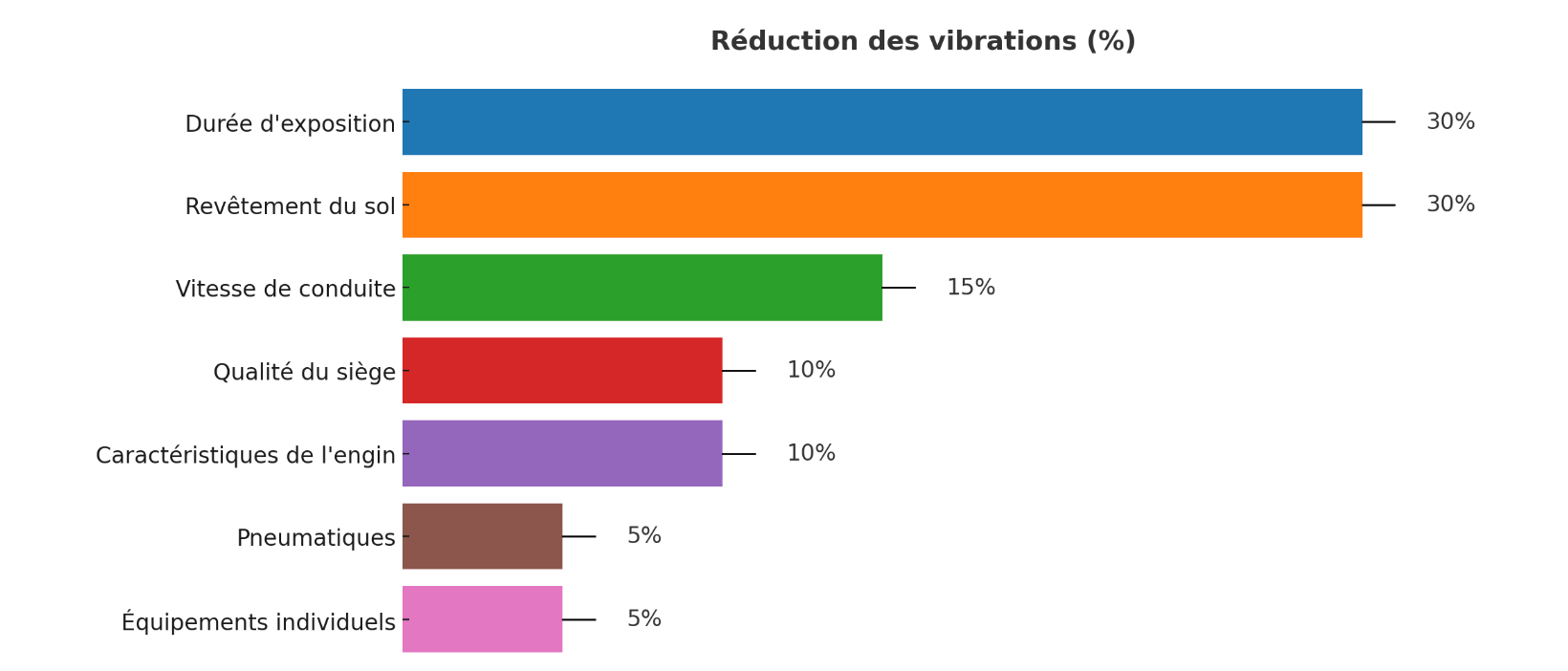
Lever #1: Exposure duration
The first lever to consider is the duration of exposure to vibration. We have observed differences of up to 30% in vibration exposure between a normal day and a busy day.
Solutions:
- Smooth out the workload over the week.
- Organize job rotation to limit continuous exposure.
Lever #2: Flooring
The type and condition of the floor significantly influence vibrations, with variations of up to 50%.
Solutions:
- Improve the maintenance and quality of floor surfaces.
- Limit irregularities and abrupt joints.
Lever #3: Driving speed
Adjusting driving speed can reduce vibrations by 15%. Going faster is not always bad: it can reduce the effect of small surface imperfections, but increase shocks.
Solution:
- Adjust speed based on the type of terrain and operating conditions.
Lever #4: Seat quality
A well-designed and properly adjusted seat can reduce vibrations by 10%.
Solutions:
- Use seats with suspension and shock-absorbing materials.
- Train drivers on how to properly adjust their seats.
Lever #5: Machine specifications
The vehicle's design also impacts vibrations (chassis, engine, cab).
Solutions:
- Choose machine models better designed to limit vibrations.
- Perform regular machine maintenance.
Lever #6: Tires
Tires can affect vibration levels by up to 5%.
Solutions:
- Use low-pressure or properly inflated air-filled tires.
- Adapt tire width to the work environment.
Lever #7: Personal equipment
Accessories such as anti-vibration cushions and lumbar supports can reduce vibrations by 5%.
Solutions:
- Provide operators with shock-absorbing mats and seats.
- Raise worker awareness regarding the use of this equipment.
Conclusion
Exposure to vibration is a major risk factor for worker health and company performance. Reducing this risk not only helps prevent MSDs but also improves worker comfort and efficiency.
To take effective action, it is essential to measure your exposure level. MOTEN supports you in this process through our innovative sensors and the expertise of our ergonomists.
You might also like these articles



© 2026 MOTEN Technologies. All rights reserved • Site created by The Gang