By
Matthieu Correa (PhD)
17 Nov 26
•
11
min read
Share this article


<script async type="module"
src="https://cdn.jsdelivr.net/npm/@finsweet/attributes@2/attributes.js"
fs-socialshare
></script>
<!-- Finsweet Attributes -->
<script async type="module"
src="https://cdn.jsdelivr.net/npm/@finsweet/attributes@2/attributes.js"
fs-copyclip
></script>
<!-- Finsweet Attributes -->
<script async type="module"
src="https://cdn.jsdelivr.net/npm/@finsweet/attributes@2/attributes.js"
fs-toc
></script>

Frequently asked questions
How is muscular effort measured at work?
In real working conditions, effort is measured with sensors placed on the skin, over the most heavily used muscles. MOTEN Analyze uses mechanomyography, which records the vibrations of a contracting muscle, and expresses effort as a percentage of maximum effort, second by second.
What does a mean effort of 35% mean?
That the muscle worked, on average over the measured period, at 35% of the maximum observed in that person. Based on 7,666 measurements, MOTEN Technologies considers that a mean effort below this benchmark corresponds to an effort perceived as sustainable by the person exerting it.
Why a lower threshold for repetitive work?
Because the effort considered acceptable decreases as the share of time spent exerting force increases: recovery time shortens and fatigue builds up. For highly repetitive work, MOTEN Technologies therefore uses a benchmark of 25%.
What is a muscular micro-rest?
A brief period during which the muscle relaxes enough to recover. A low proportion of micro-rest is associated with a higher risk of pain, particularly in the trapezius.
Muscular effort is usually measured when a deeper understanding of the demands of an activity is needed. Which movement costs the most among hundreds of others? What real effect does a piece of equipment have on its users when subjective feedback diverges? Which technique best protects operators, staff and craftspeople? Measuring effort is invaluable for making informed, objective decisions about design, integration, workplace layout or training.
What is muscular effort?
A muscle is organised into motor units, each made up of a motor neuron and the fibres it “commands”. To produce a contraction, the nervous system recruits these units and increases their firing rate. Muscular effort is the internal demand that produces this contraction, relative to the muscle's capacity.
This effort depends on many internal and external factors. It depends on the physical capacities of the person producing it, their sex, their size (above all, the length of their lever arms), their body fat percentage, and so on. In ergonomics, we focus mainly on external factors and how they interact with the operator being followed: the tools used, the techniques employed, the movement performed, how long it lasts, the posture adopted, and so on. Ultimately, two employees who appear to be doing the same thing can produce very different efforts because these factors add up.
The more intense a contraction, the shorter the time it can be sustained (Frey-Law and Avin, 2010). Even at very low intensity, while the muscle's blood flow remains sufficient, fatigue eventually sets in if the contraction goes on (Sjøgaard, Savard and Juel, 1988). Recovery therefore matters all the more.
For MOTEN Technologies, effort is therefore read along three measurable dimensions: its intensity, its duration and recovery time... and dozens of other observable ones, which we will not list here since they depend on the characteristics of the work situation observed.
How does MOTEN Technologies measure effort?
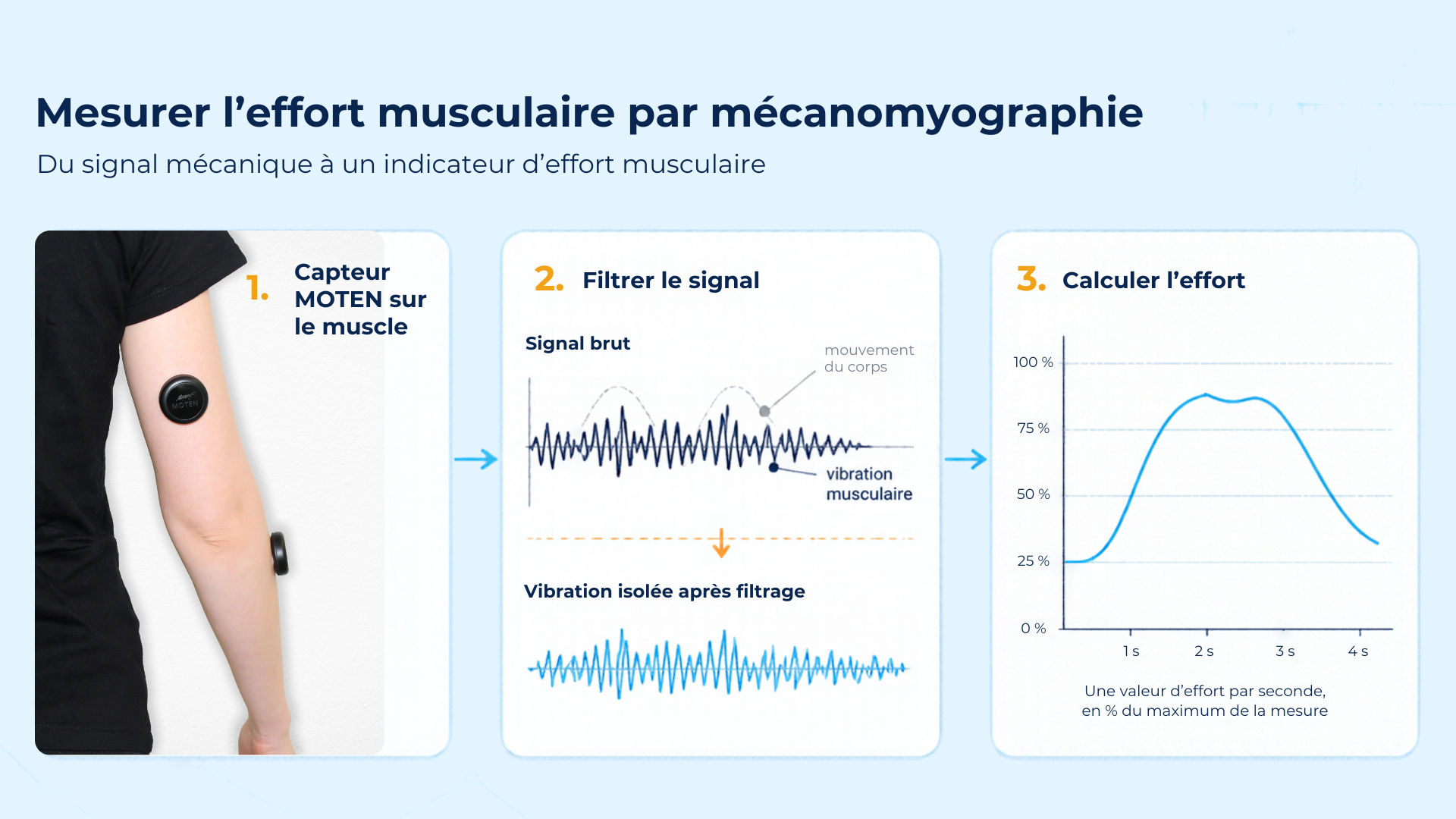
A contracting muscle vibrates. Its active fibres oscillate laterally at low frequency; the amplitude of these oscillations increases with the number of motor units recruited, while their frequency content reflects the firing rate (Beck et al., 2005). Mechanomyography, or MMG, records these vibrations using an accelerometer placed on the skin, over the muscle.
MOTEN Technologies uses mechanomyography because it requires no shaving, no gel and no electrode to be positioned to the millimetre, and it copes with sweat and long working days alike, which makes it suited to work as it is actually done, on a construction site as well as indoors. Compared with surface electromyography (sEMG), the historical reference, MMG proved just as reproducible in static contraction and tracked load variations of the biceps and triceps more faithfully during a lifting task (Correa et al., 2023). The same accelerometer also picks up the movements of the body wearing it; a filtering method developed by MOTEN Technologies and the CIAMS laboratory at Université Paris-Saclay separates muscle vibration from these movements (Correa et al., 2025).
The sensors are placed on the muscles that a preliminary observation of the workstation and discussions with the people involved identify as the most heavily used. The signal is then condensed into one value per second and per muscle, a resolution chosen to follow an activity for hours without drowning the analysis, and which can be refined when the work consists of very brief movements. Finally, each value is expressed as a percentage of maximum effort: for each muscle, the most intense contraction recorded during the measurement serves as the reference, and every second is expressed relative to it. An effort of 40% means that, at that moment, the muscle is working at 40% of the maximum measured in that person.
What indicators does muscular effort produce?
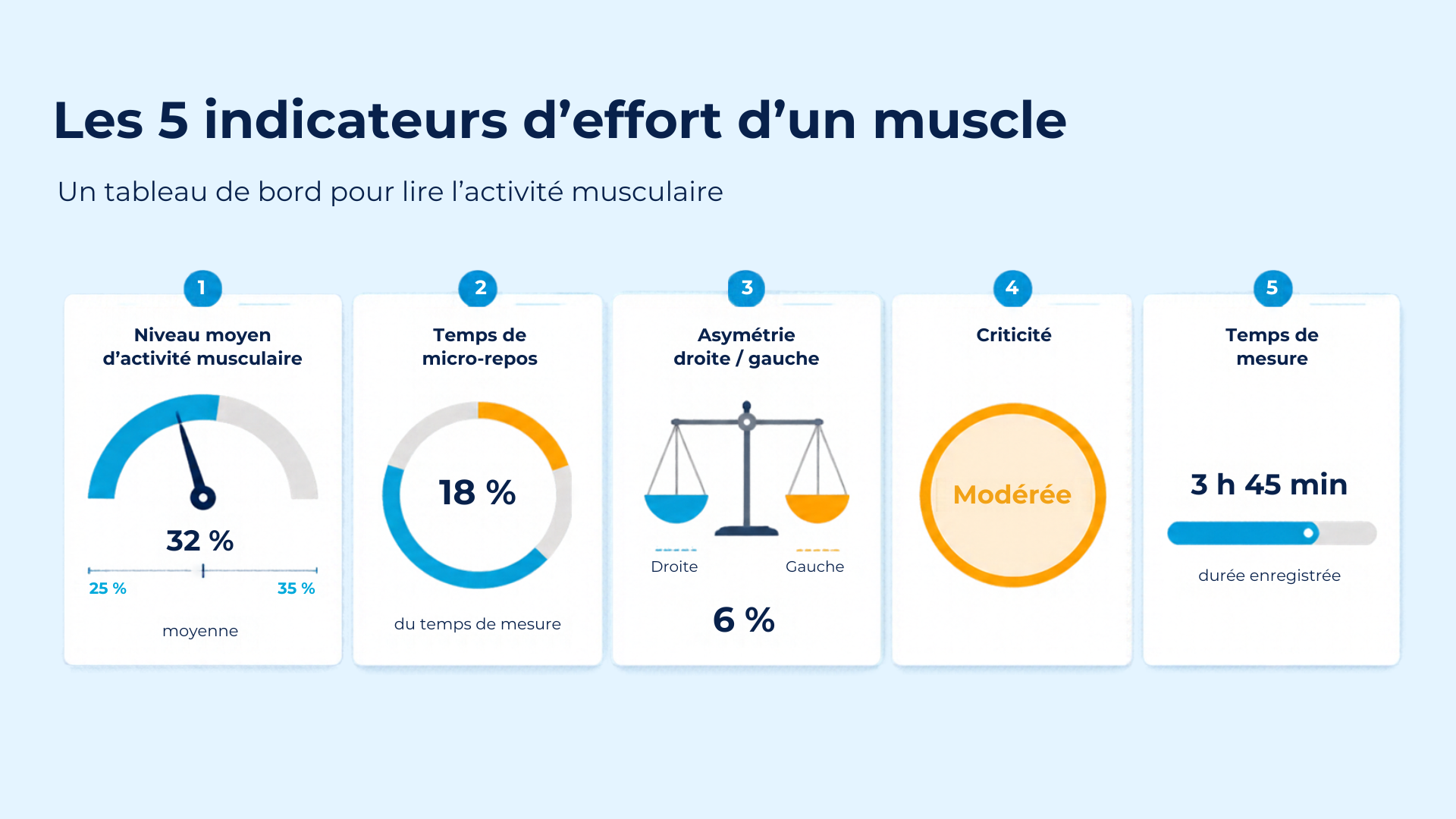
From this series of values, MOTEN Analyze derives five effort indicators, which are read together and/or alongside others such as postural risk, repetitive movements or vibration.
Micro-rest time
When a muscle works, even lightly, it is always the same small motor units that are recruited first and remain active for as long as the contraction lasts: this is the so-called “Cinderella” hypothesis, put forward by the Swedish researcher G. M. Hägg in 1991. Short breaks in muscle activity are their only opportunities to recover. In a chocolate factory where thirty newly hired women were followed during their first year, those who developed trapezius myalgia showed fewer of these breaks throughout the follow-up than their colleagues who remained pain-free (Veiersted, Westgaard and Andersen, 1993).
Asymmetry
Asymmetry is a reminder that the body rarely shares the work equally. In 77 office workers recorded over one to two full working days, the trapezius on the dominant side showed higher activity and less rest than the one on the opposite side (Marker et al., 2016). With a broom or a squeegee, the hand at the top of the handle does not play the same role as the one at the bottom; measuring both sides shows which one carries the load, and whether a change of tool or method rebalances it.
Criticality
Finally, criticality places effort within a more complex system. Moderate effort becomes a concern when it adds up, on the same muscle and joint chain, with an awkward posture, repetitive movements, vibration or long exposure, all factors that MOTEN Analyze also measures. Research describing MSDs as a tissue fatigue process, comparable to that of materials subjected to repeated loads, stresses precisely this interaction between force and repetition (Gallagher and Schall, 2017).
What is the muscular effort indicator used for?
Prioritise
Muscular effort makes it possible to prioritise. Broken down by task, effort shows which task costs the most, and for which part of the body. Inconspicuous tasks, with little added value or too embedded in the routine to be mentioned, often come top of the list.
Compare
Two tools, two methods, two layouts can be decided between on the basis of figures. Exoskeleton assessment is certainly the best-known example. The same goes for other technical aids (cobots, hoists, manipulators, power tools): measurement checks that they genuinely reduce effort rather than shifting it to another muscle.
Comparing leads to choosing. Before a purchase, two tools or two trolleys can be tested in real working conditions by the employees who will use them, rather than chosen on the supplier's data sheet alone.
Design
Measured on existing workstations, effort makes it possible to set a target effort level in the specifications of a new workstation, tool or line, before they even exist.
Verify
Measured before and after an intervention, effort shows whether it delivers on its promises, and not just on the day of the trial: a new measurement a few months later shows whether the solution has been adopted and whether its effects last.
Organise
Knowing which muscles each task uses makes it possible to build rotations between workstations that load different parts of the body, rather than between workstations that are merely different on paper. Micro-rest time likewise sheds light on the timing of breaks and the choice of work pace.
Pass on
Among other examples, we supported a company in measuring the (very positive) effects of protective movements and handling techniques developed by the employees themselves, with a view to building these techniques into on-the-job training. Comparing the movements of experienced employees and beginners also shows what experience saves the muscles, and feeds into the transmission of know-how.
Go further
Muscular effort is an indicator that makes it possible to go beyond what can be observed (postural analysis in particular) by revealing internal demands that cannot be seen with the naked eye and that operators struggle to identify themselves. The results are very useful for ending debates and moving on to a constructive dialogue grounded in the work itself.
What are the prospects for measuring effort?
Advancing the science of movement
Each new measurement campaign enriches the database on which the benchmarks rest; with the 2026 measurements, the aim is to refine them by muscle, by trade and by population. This will bring new insights, unprecedented in occupational risk prevention.
Matthieu Correa's PhD thesis, defended in 2024 at Université Paris-Saclay as part of work carried out with MOTEN Technologies, showed that MMG can detect upper-limb fatigue during repetitive tasks, using indicators of its own (Correa, 2024). Validation in real working conditions is the next step. Detecting fatigue as it sets in means being able to objectively assess the effect of a break, a rotation or a change of pace.
In occupational health, prospects for anticipating and predicting work-related wear and tear
- Understanding effort, how it is mobilised and how it deteriorates (as fatigue sets in) opens up new prospects for designing work situations, tools and operator equipment through simulation.
- Estimating the rest time a muscle needs after a sequence of effort would make it possible to size breaks on data rather than on habit.
- Combining effort with postural risk, repetitive movements and vibration, which MOTEN Analyze already measures, and even with heart activity, to characterise each workstation with a single index.
- Measuring cumulative exposure by tracking effort no longer over a single day but over months, or even a whole career, ties in with research describing MSDs as a tissue fatigue process (Gallagher and Schall, 2017).
- Automatically recognising tasks: since the sensor also records movement, artificial intelligence could break activity down into tasks and attach effort to them, reducing the need for video.
What are the advantages and limitations?
The table below sums up what the indicator brings and where its limits lie.
| Aspect | Advantages | Limitations |
|---|---|---|
| Reading the activity | Seeing what the eye cannot see The internal load on muscles becomes measurable, whereas observation, even by experts, overestimates the intensity of efforts (Lowe and Krieg, 2009). | A figure that needs context It shows how much a movement costs, not why: observing the work and talking with operators remain essential to interpret it. |
| Task prioritisation | The most demanding tasks at the top of the list Ranking by muscular cost brings the most demanding tasks to the surface, including those nobody had flagged. | A view limited to the muscles equipped The choice of muscles, made beforehand on the basis of observing the workstation, determines what can be seen. |
| Comparisons | Highly detailed comparisons Before and after, tool A or tool B, right or left side: within the same person, the differences are clear to read. It is the most widely used criterion for evaluating exoskeletons (de Looze et al., 2016). | A relative value, not a force Expressed as a % of each person's maximum, effort cannot be converted into kilograms (Mathiassen, Winkel and Hägg, 1995) and is compared first and foremost within the same individual. |
| Benchmarks | Benchmarks born in the field 7,666 measurements were used to build an initial reading grid: 35% of maximum effort on average, 25% for highly repetitive work. | No official threshold yet Limit values for physical workload are still at the proposal stage (Arvidsson et al., 2021); MOTEN Technologies' benchmarks have yet to be published. |
| Understanding | A common language for dialogue The figure objectifies what operators experience and helps move beyond debates based on impressions, all the more so as perceived and measured effort do not always match (Thamsuwan et al., 2023). | An indicator that takes learning A percentage of maximum effort is neither a force nor a risk score: reading it requires guidance. |
| Representativeness | Real work, continuously Second by second, for hours, at the workstation: peaks, durations and recovery times are recorded as they happen. | Several measurements for an accurate picture Effort varies from one person and one day to the next (Mathiassen and Paquet, 2010): a workstation is characterised across several employees and several situations. |
Muscular effort has long been the risk factor people estimated for want of being able to measure it. Measuring it during real work changes the nature of the discussion: the question is no longer why a job “is hard”, but which movement is responsible, which muscles are used, for how long, and with what opportunities to recover.
MOTEN Technologies is currently the only company using mechanomyography to assess effort in real working conditions. To understand how it differs from electromyography, read MMG vs EMG: what are the differences?. To measure effort at your own workstations (on your own or with our support), contact us!
You might also like these articles



© 2026 MOTEN Technologies. All rights reserved • Site created by The Gang