By
Matthieu Correa (PhD)
23 Nov 26
•
11
min read
Share this article


<script async type="module"
src="https://cdn.jsdelivr.net/npm/@finsweet/attributes@2/attributes.js"
fs-socialshare
></script>
<!-- Finsweet Attributes -->
<script async type="module"
src="https://cdn.jsdelivr.net/npm/@finsweet/attributes@2/attributes.js"
fs-copyclip
></script>
<!-- Finsweet Attributes -->
<script async type="module"
src="https://cdn.jsdelivr.net/npm/@finsweet/attributes@2/attributes.js"
fs-toc
></script>

Frequently asked questions
Posture is the risk factor that is relatively easy to grasp, because it can be seen. A bent back, an arm raised above the shoulder or a flexed knee is obvious to anyone observing a workstation. How long and how often a posture is adopted, on the other hand, can be harder to pin down, depending on the activity performed. Measuring postural risk objectively is a quick and less burdensome way to prioritise tasks, decide between workstation layouts and choose improvements to the work situations observed.
What is postural risk?
Each joint has a neutral zone in which the surrounding muscles, tendons and ligaments do little work. As the body segment moves away from it, tendons stretch or are compressed, stabilising muscles contract to hold the position, and the load increases with the range of motion. Postural risk refers to this strain and its contribution to the onset of musculoskeletal disorders (MSDs). The French Labour Code lists it among marked physical constraints, as "strenuous postures defined as forced joint positions", alongside manual handling of loads and mechanical vibration (INRS).
Range of motion alone is not enough to describe the risk. In a car assembly plant, back disorders were associated with mild as well as severe trunk flexion, and with twisting and lateral bending, and the risk increased with exposure time and the accumulation of postures (Punnett et al., 1991). In the Netherlands, a three-year follow-up of 861 workers showed that working with the trunk flexed by at least 60° for more than 5% of working time increased the risk of low back pain (Hoogendoorn et al., 2000). For the shoulder, each percentage point of the day spent with the arm raised above 90° was accompanied by an increased risk of supraspinatus tendinitis (Svendsen et al., 2004).
Holding time matters too. Even a moderately uncomfortable posture can only be held for a few minutes before discomfort peaks. Based on experimental data, Dutch researchers recommend not holding it for more than one minute at a time (Miedema, Douwes and Dul, 1997).
For MOTEN Technologies, postural risk is therefore read along three measurable dimensions: the range of the posture, the share of time it takes up and how long it is held without interruption.
How does MOTEN Technologies measure postural risk?
Measurement starts from the angle of each joint being tracked. MOTEN Technologies obtains it using two complementary tools.
MOTEN sensors are equipped with an accelerometer and an inertial measurement unit (IMU). Placed on the body to measure muscular effort, they also record the orientation of the segment wearing them relative to the vertical, and therefore the angle of the corresponding joint. They measure the back, shoulders, elbows and knees, provided they are placed there, and track them over hours of work, wherever the person moves and without depending on a camera's field of view. Effort and posture are then recorded at the same moment, on the same body area.
Video analysis works differently: a camera films the workstation, and an algorithm detects the joints frame by frame and calculates their angles, without placing anything on the employees. It measures the same joints as the sensors, and others besides: the neck, wrists and fingers, on both sides of the body. It can also be deployed quickly across many workstations. Its accuracy, however, depends on what the camera sees: a segment hidden by an object, a colleague or the body itself is less well estimated.
The two sources complement each other. There is no need to equip a person from head to toe: sensors are placed on the areas that observation of the workstation identifies as the most heavily used, and video covers the rest of the body.
The angle is assigned to one of four posture levels: neutral, mild, marked or extreme. These levels use the boundaries of two observation grids widely used in ergonomics, RULA for the upper limbs (McAtamney and Corlett, 1993) and REBA for the whole body (Hignett and McAtamney, 2000), which give each segment a score according to its angle. The reference grid, RULA or REBA, is chosen according to the joints measured.
| Area | Source | Neutral | Mild | Marked | Extreme |
|---|---|---|---|---|---|
| Back | Sensor, video | Upright | 0–20° | 20–60° | > 60° |
| Shoulder (arm raised) | Sensor, video | ≤ 20° | 20–45° | 45–90° | > 90° |
| Knee | Sensor, video | ≤ 30° | — | 30–60° | > 60° |
| Elbow | Sensor, video | 60–100° | — | Outside 60–100° | — |
| Neck, wrists, fingers | Video | RULA or REBA thresholds, depending on the joints measured | |||
As in RULA and REBA, the knee and the elbow have fewer levels: the knee goes straight from a neutral to a marked posture, and the elbow has a single threshold, depending on whether it works inside or outside its comfort range. A marked or extreme posture held for more than 60 seconds also counts as a prolonged hold.
These thresholds, taken from RULA and REBA, make up the base method. They can be configured to match the grids of companies that have built their own assessment method, so that results can be read against the frame of reference already in use on site.

What indicators does postural risk produce?
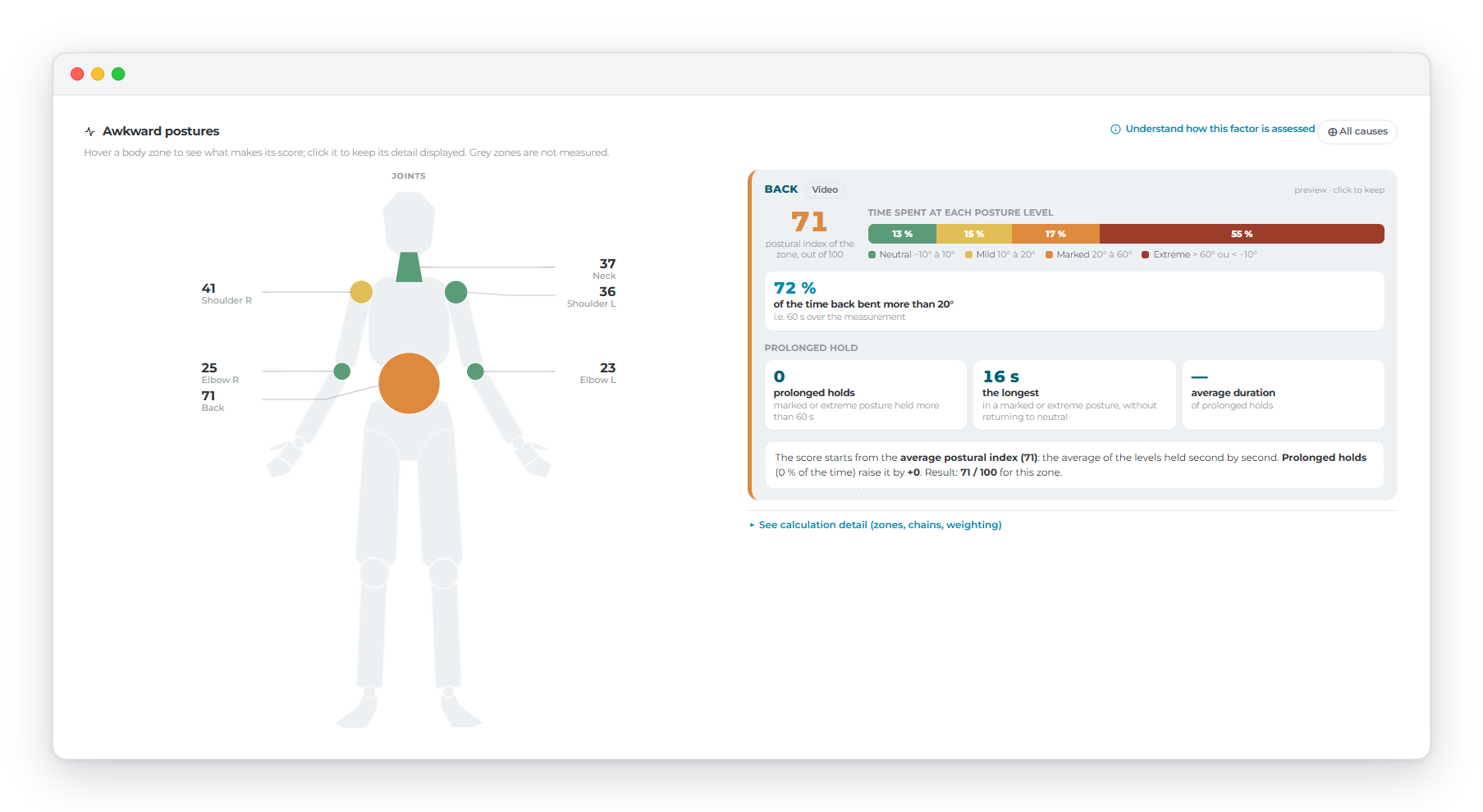
From this series of levels, MOTEN Analyze derives three indicators, calculated for each measured area and then for the whole body. They are read together and alongside others, such as muscular effort, repetitive movements or vibration.
The postural index
The postural index is the average of the posture levels over the entire measurement period, expressed out of 100. It combines range and duration in a single figure: an area that spends a lot of time in a marked posture and an area that occasionally reaches an extreme one can obtain similar indices, and it is the area's breakdown that tells them apart. Take an operator who spends 60% of their time with their back bent forward by more than 20°: their postural index for the back is 45.
Prolonged holds
A marked or extreme posture held for more than 60 consecutive seconds counts as a prolonged hold. This threshold is in line with the recommendations on holding times mentioned above: a posture held without interruption gives the stabilising muscles no chance to relax. Prolonged holds increase the area's score, by up to 10 points when they cover 3% of the measurement time. Our operator holds their posture for more than a minute several times, i.e. 1.5% of the time: the holds add 5 points, and the back scores 50 out of 100.
Criticality by chain
Areas on the same side of the body form a chain: the shoulder and elbow of the same arm make up an arm chain, and the back and neck make up the spinal chain. Reasoning by chain is a reminder that a raised arm and an elbow outside its comfort range load the same muscles and tendons, and that the body rarely shares the load equally between left and right.
The postural factor score then weights the three most heavily loaded chains: six for the first, three for the second, one for the third. These weights are not arbitrary. They come from a Shapley analysis, a game theory method that measures the average contribution of each element to an outcome, applied to every posture combination possible in the REBA tables: the worst chain weighs six times more than the third.
What are postural risk indicators used for?
Prioritise
Broken down by task, the indicators show which task exposes workers the most, and which body area. Tasks performed close to the floor or above shoulder height often come top of the list, even when they are brief and nobody mentions them: restocking at height, end-of-shift cleaning, an adjustment underneath a machine.
Compare
Two worktop heights, two shelving layouts or two tools can be decided between on the basis of figures. Measurement checks that a layout change genuinely reduces the time spent in marked postures, rather than shifting the strain to another joint: a raised worktop relieves the back but may make people raise their arms. Testing in real working conditions, with the employees who will use the equipment, avoids choosing on the supplier's data sheet alone.
Design
Measured on existing workstations, postures provide quantified targets for the specifications of a new workstation or line: pick-up and put-down heights, reach zones, the acceptable share of time with arms raised. The workstation is then designed around measured angles rather than around an average template.
Verify
Measured before and after an intervention, the postural index shows whether it delivers on its promises. A new measurement a few months later shows whether the layout change has been adopted, or whether old ways of working, often justified by constraints the project had overlooked, have taken over again.
Organise
Knowing which areas each task loads makes it possible to build rotations between workstations that use different joints, rather than between workstations that are merely different on paper. Prolonged holds, for their part, shed light on where micro-breaks and changes of position belong.
Combine with effort
Posture can be seen; effort cannot. An arm stretched out at chest height may be holding a heavy tool or nothing at all; an upright back may conceal a forceful grip. Read alongside muscular effort, measured by the same sensors, posture shows where the body is under strain, and effort shows how much it costs.
What are the prospects for measuring postural risk?
Rating every plane of movement
Twisting and lateral bending of the trunk are associated with back disorders just as flexion is (Punnett et al., 1991). Along with wrist postures, they are also among what observation struggles most to estimate correctly (Takala et al., 2010). Including them in the score, like shoulder abduction, is one of the next developments planned for the method.
Making video more reliable
Video-based posture estimation is progressing quickly, but its limitations are documented. In a study of dental assistants, agreement between video and inertial sensors was moderate for the overall RULA score but poor area by area, particularly for the upper limbs (Simon et al., 2025). Using video to screen many workstations, and sensors to quantify where the stakes justify it, makes the most of both.
Tracking exposure over time
One day of measurement is still just one day. Tracking postures over several weeks, across several employees and several teams, would capture the real variability of work and link measured exposure to the onset of complaints, so that thresholds can be refined on health data rather than on observation grids.
A single index per workstation
Combining postural risk with muscular effort, repetitive movements and vibration, which MOTEN Analyze already measures, paves the way for a single physical workload index per workstation, comparable from one site to another and from one year to the next.
What are the advantages and limitations?
The table below sums up what these indicators bring and where their limits lie.
| Aspect | Advantages | Limitations |
|---|---|---|
| Duration | Every second counts Time spent and holds finally quantified. | A single plane of movement Only flexion-extension is rated for now. |
| Reference | Recognised thresholds The RULA and REBA grids, familiar to prevention professionals. | Observation grids Designed to rate a single moment, applied here continuously. |
| Tailoring | Your own thresholds The method aligns with your internal grid. | Comparisons need framing Two sites with different thresholds cannot be compared directly. |
| Coverage | Sensor or video The precision of sensors, the reach of video. | Blind spots Sensors only see the areas they are placed on, video only what it films. |
| Field | Real work At the workstation, cycle after cycle. | A snapshot if the measurement is short A few seconds cannot replace several hours. |
| Dialogue | Readable at a glance A colour-coded body figure that opens the discussion. | A score, not a diagnosis It shows which posture is adopted, not why. |
Posture has long been assessed by eye, at the moment the observer happened to be watching. Measuring it continuously changes the question: the issue is no longer whether a workstation involves awkward postures, since almost all do, but how long they last, how far they go and which chain of the body they concentrate on.
In France, strenuous postures are one of the three ergonomic risk factors, along with manual handling and mechanical vibration, whose prevention can be co-funded by the FIPU, the fund for the prevention of occupational wear and tear (article in French).
To combine posture with the effort it requires, read Muscular effort: a high-potential indicator for occupational health. To measure postural risk at your own workstations (on your own or with our support), contact us!
You might also like these articles



© 2026 MOTEN Technologies. All rights reserved • Site created by The Gang